Perfume Manufacturing Process: 6 Steps from Fragrance to Finished Product
A detailed look at the perfume manufacturing process, from fragrance composition to retail-ready packaging. Understand how private label perfumes are made in a modern facility.
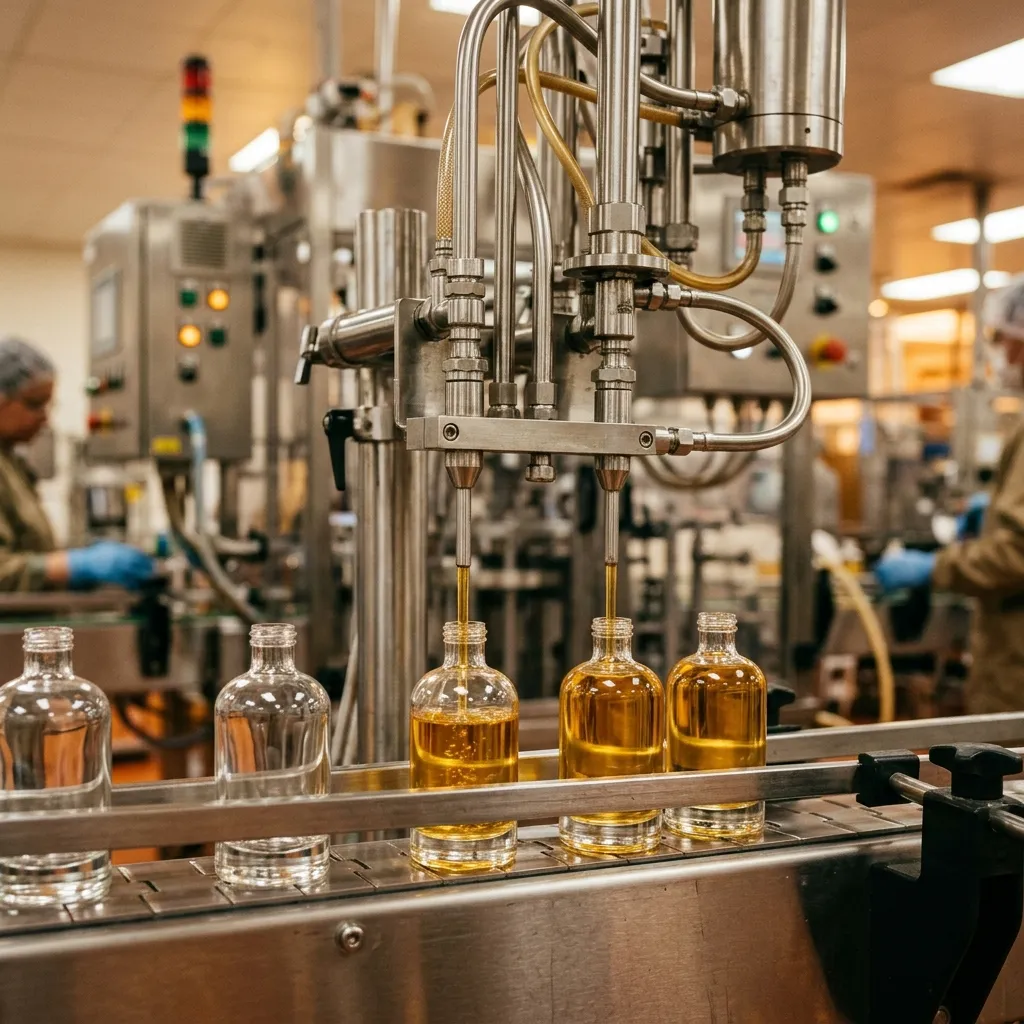
Brand owners who understand the manufacturing process negotiate better, set realistic timelines, and catch quality issues early. This guide walks through the six-stage perfume manufacturing process as it runs at a modern private label facility — from raw fragrance compounds to dispatch-ready cartons.
Key Takeaways
- Perfume manufacturing involves 6 core steps: composition, bottle making, cap production, filling, packaging, and quality control
- Maceration (ageing) is crucial for fragrance quality — expect 2–8 weeks for proper integration
- End-to-end manufacturers who handle all 6 steps under one roof offer faster timelines and better quality consistency
- A standard production run takes 2–4 weeks from approved components to dispatch
- IFRA compliance is checked at the composition stage — before any production begins
Step 1: Fragrance Composition
Every perfume starts at the composition bench. This stage determines what the fragrance smells like, how long it lasts, and whether it meets safety regulations.
The composition process
A perfumer (also called a "nose") creates a fragrance by blending:
- Top notes — The first impression. Light, volatile molecules that evaporate within 15–30 minutes. Examples: citrus, bergamot, green apple, mint.
- Heart notes — The core of the fragrance. Emerge after top notes fade, lasting 2–4 hours. Examples: rose, jasmine, lavender, geranium, cardamom.
- Base notes — The foundation. Heavy, long-lasting molecules that anchor the fragrance for 6–12+ hours. Examples: sandalwood, musk, amber, oud, vanilla, patchouli.
Fragrance concentrations
| Type | Oil Concentration | Alcohol | Longevity | Cost |
|---|---|---|---|---|
| Parfum (Extrait) | 20–40% | 60–80% | 8–12+ hours | Highest |
| Eau de Parfum (EDP) | 15–20% | 80–85% | 6–8 hours | High |
| Eau de Toilette (EDT) | 5–15% | 85–95% | 3–5 hours | Medium |
| Eau de Cologne | 2–5% | 95–98% | 1–3 hours | Low |
| Body Mist | 1–3% | 97–99% | 1–2 hours | Lowest |
| Attar | 8–15% (oil-based) | No alcohol | 8–12 hours | Varies |
IFRA compliance
Every fragrance formula must comply with IFRA (International Fragrance Association) standards. IFRA restricts or bans specific ingredients based on dermatological safety data. Compliance is verified before production begins — a reputable manufacturer will never skip this step.
Maceration
After the fragrance concentrate is blended with the carrier (denatured alcohol for sprays, carrier oil for attars), the mixture undergoes maceration — an ageing process where the blend rests in sealed stainless steel tanks for 2–8 weeks.
During maceration:
- Scent molecules integrate fully with the alcohol carrier
- Harsh or sharp edges in the fragrance soften
- The scent profile develops depth and complexity
- Chemical equilibrium is established
After maceration, the blend undergoes cold filtration — chilling to -5°C to -10°C to precipitate and remove waxy residues, then filtering through fine mesh. This produces a crystal-clear liquid ready for filling.
Step 2: Bottle Manufacturing
Glass bottles are the primary container for perfumes. The manufacturing process depends on the bottle type.
Glass bottle production methods
Mould blowing — Molten glass is blown into a mould. Produces consistent shapes at scale. Used for most commercial perfume bottles.
Press-and-blow — For heavier, more complex bottle shapes. The glass is first pressed into a parison, then blown into the final mould.
Tubing — For simple cylindrical bottles (like attar bottles). Glass tubes are heated and shaped.
Post-processing
After forming, bottles go through:
- Annealing — Slow cooling in a controlled oven (lehr) to relieve internal stresses
- Inspection — Checking for cracks, bubbles, uneven walls, and dimensional accuracy
- Surface treatment — Frosting, spraying, coating, electroplating, metallisation, or acid etching for decorative finishes
- Printing — Screen printing, hot stamping, or UV printing for logos and branding directly on glass
At Fragrance & Fashion, bottle manufacturing happens on-site, allowing rapid prototyping and tight coordination with the filling line.
Step 3: Cap and Closure Manufacturing
Caps serve both functional (sealing, protecting the spray mechanism) and aesthetic purposes. They're often the most noticed tactile element of a perfume.
Cap materials
| Material | Feel | Weight | Best For | Cost |
|---|---|---|---|---|
| Zamac (zinc alloy) | Heavy, premium | 30–80g | Luxury, gifting | High |
| Aluminium | Medium, sleek | 15–40g | Premium modern | Medium-High |
| ABS plastic | Light, versatile | 5–15g | Mass market | Low |
| Surlyn | Crystal-clear | 10–25g | Luxury transparent | High |
| Wood | Warm, organic | 15–40g | Niche, artisanal | Medium-High |
| Magnetic | Satisfying click | Varies | Premium convenience | High |
Manufacturing processes
- Die casting — For zamac/metal caps. Molten metal is injected into a die under pressure.
- Injection moulding — For plastic and surlyn caps. Melted polymer injected into a mould.
- CNC machining — For wood caps. Wood blanks are turned on a lathe.
Post-processing includes polishing, electroplating (gold, silver, rose gold), anodising, lacquering, and logo engraving.
Step 4: Precision Filling
Filling is where the fragrance liquid meets the bottle. Precision is critical — underfilling means customer complaints; overfilling means wasted product and inconsistent weights.
Filling methods
Vacuum filling — The bottle is placed under vacuum, and the liquid is drawn in by pressure differential. Best for consistent fill levels across varying bottle shapes.
Gravity filling — Liquid flows into the bottle by gravity from an overhead tank. Simple and reliable for uniform bottles.
Volumetric filling — A precise volume is measured by a piston or flow meter before dispensing. Most accurate for high-value fragrances.
The filling line sequence
- Bottle washing — Bottles are cleaned with deionised water and air-dried to remove dust and debris
- Filling — Fragrance is dispensed into the bottle through a nozzle
- Spray pump insertion — The spray mechanism (actuator and dip tube) is placed into the bottle neck
- Crimping — A metal ferrule is crimped around the bottle neck to permanently seal the spray pump. This is a one-way process — once crimped, the bottle cannot be opened without destroying the seal
- Cap fitting — The decorative cap is placed over the spray mechanism
- Weight check — Each filled bottle is weighed to verify correct fill volume
At Fragrance & Fashion, our filling line has a capacity of approximately 3 million units per year, running across multiple shifts to meet demand from 240+ brand partners.
Step 5: Packaging
Packaging transforms a filled bottle into a retail-ready product. It protects the glass during transit, communicates brand identity, and complies with labelling regulations.
Packaging components
- Primary packaging — The bottle itself (already filled and capped)
- Secondary packaging — The box that holds the bottle. Options include rigid boxes, folding cartons, sleeves, or pouches
- Insert/tray — A moulded or die-cut insert that holds the bottle securely inside the box
- Overwrap — Cellophane or shrink wrap that seals the box for tamper evidence
- Label — Applied to the bottle and/or box with regulatory information
Labelling requirements (India)
| Element | Required? | Standard |
|---|---|---|
| Product name | Yes | — |
| Ingredients (INCI) | Yes | BIS/IFRA |
| Net quantity | Yes | Legal Metrology |
| MRP | Yes | Legal Metrology |
| Manufacturing date | Yes | BIS |
| Expiry / Best before | Yes | BIS |
| Batch number | Yes | GMP |
| Manufacturer name & address | Yes | BIS |
| Country of origin | Yes (export) | Destination country |
| Barcode | Recommended | — |
Box manufacturing
Rigid boxes for premium perfumes are constructed from grey board wrapped in printed paper or fabric. The manufacturing process includes:
- Die cutting the grey board to exact dimensions
- Printing the wrap paper (offset, digital, or letterpress)
- Laminating (matte, gloss, soft-touch)
- Foil stamping or embossing for logo and details
- Board wrapping and gluing
- Magnet or ribbon closure insertion (if applicable)
- Insert/tray placement
Step 6: Quality Control
Quality control in perfume manufacturing spans every step but culminates in final inspection before dispatch.
QC checkpoints
| Stage | What's Checked | Method |
|---|---|---|
| Incoming raw materials | Fragrance oil purity, alcohol grade, glass quality | GC-MS, visual inspection |
| Fragrance blending | IFRA compliance, colour, specific gravity | Lab analysis |
| Maceration | Stability, clarity, scent development | Time-based sampling |
| Bottle inspection | Cracks, bubbles, dimensions, cosmetic defects | Visual + gauge |
| Filling | Fill volume, weight accuracy, spray function | Gravimetric, functional test |
| Packaging | Print quality, box construction, labelling accuracy | Visual inspection |
| Final product | Drop test, spray count, shelf stability | Accelerated aging chamber |
Batch documentation
Every production batch is documented with:
- Batch number and date
- Fragrance formula reference
- Raw material lot numbers
- Filling records (volume, temperature)
- QC test results
- IFRA certificate
- Retention samples (stored for 2+ years)
This documentation is essential for traceability, regulatory compliance, and resolving any post-sale quality queries.
End-to-End vs. Multi-Vendor Manufacturing
| Factor | End-to-End (Single Manufacturer) | Multi-Vendor |
|---|---|---|
| Coordination | Single point of contact | You manage 3–5 vendors |
| Timeline | 8–12 weeks | 12–20 weeks |
| Quality consistency | Controlled across all components | Variable across vendors |
| Communication | Simplified | Complex |
| Cost | Often competitive (volume bundling) | Potentially lower per-component |
| Accountability | Clear — one manufacturer owns the outcome | Fragmented |
| Minimum investment | Higher per vendor, lower total | Lower per vendor, higher total |
At Fragrance & Fashion, we operate as an end-to-end manufacturer — all six steps happen in our Moriya, Ahmedabad facility. This means your fragrance, bottle, cap, box, filling, and QC are produced under one roof by one team, with one timeline and one point of accountability.
How Fragrance & Fashion Manufactures
Our six-step process mirrors the stages outlined above, optimised for private label and OEM clients:
- Brief — We understand your brand, market, and budget
- Scent — Our perfumers develop custom fragrances or refine selections from our library
- Vessel — Glass bottles manufactured or selected in-house
- Label — Caps, decoration, and packaging designed and produced
- Fill — Precision filling, crimping, and assembly
- Ship — QC, documentation, and dispatch to your warehouse or distribution partner
See this process in action through our case studies — including how we helped Hoor 72 launch with 24 attar variants and Drooks Lifestyle build a premium fragrance line.
Ready to start manufacturing? Send us a brief or reach out on WhatsApp.
Frequently Asked Questions
Perfume manufacturing involves six core steps: (1) fragrance composition — blending aromatic compounds, essential oils, and aroma chemicals to create the scent; (2) bottle manufacturing — glass blowing or moulding; (3) cap and closure production; (4) precision filling — measuring and dispensing the fragrance into bottles; (5) packaging — boxing, labelling, and shrink-wrapping; (6) quality control — stability testing, batch documentation, and compliance verification.
Perfume manufacturing uses aromatic compounds (natural essential oils, synthetic aroma chemicals, absolutes, and resins), a carrier solvent (typically denatured ethanol/alcohol for spray perfumes, or a carrier oil for attars), and optionally fixatives and stabilisers. The packaging requires glass, metal (zamac or aluminium for caps), cardboard, paper, and printing inks.
A typical production run takes 2–4 weeks from start to dispatch, assuming all components (bottles, caps, packaging) are ready. If custom moulds or new fragrance development is involved, add 4–8 weeks. At Fragrance & Fashion, our end-to-end facility reduces timelines because fragrance, glass, caps, and packaging are all manufactured on the same premises.
A perfume manufacturing facility requires: mixing tanks and agitators for fragrance blending, a glass furnace or moulding equipment for bottles, injection moulding or die-casting equipment for caps, a filling line (vacuum or gravity fillers, crimping machines), labelling machines, and quality testing equipment (gas chromatography, stability chambers).
Maceration is the ageing process after the fragrance concentrate is blended with alcohol. The mixture is stored in stainless steel tanks for 2–8 weeks (or longer for premium fragrances) to allow the scent molecules to fully integrate. This step improves fragrance complexity and longevity. The macerated blend is then chilled (cold filtration) to remove sediments before filling.
 Startup Guides
How to Start a Perfume Brand in India: Complete 2026 Guide
How to launch a perfume brand in India. From choosing a manufacturing partner and developing fragrances to licensing, packaging, and your first production run with MOQ as low as 1,000 units.
 Private Label
Private Label Perfume Manufacturer: How to Choose the Right Partner in India
How to choose a private label perfume manufacturer in India. What to look for in capabilities, MOQ, certifications, pricing models, and what end-to-end manufacturing actually includes.
 OEM Manufacturing
OEM vs Private Label Perfume Manufacturing: Key Differences Explained
Understand the differences between OEM and private label perfume manufacturing. Compare ownership, control, pricing, MOQ, and which model suits your brand.