Private Label Perfume Manufacturer: How to Choose the Right Partner in India
How to choose a private label perfume manufacturer in India. What to look for in capabilities, MOQ, certifications, pricing models, and what end-to-end manufacturing actually includes.
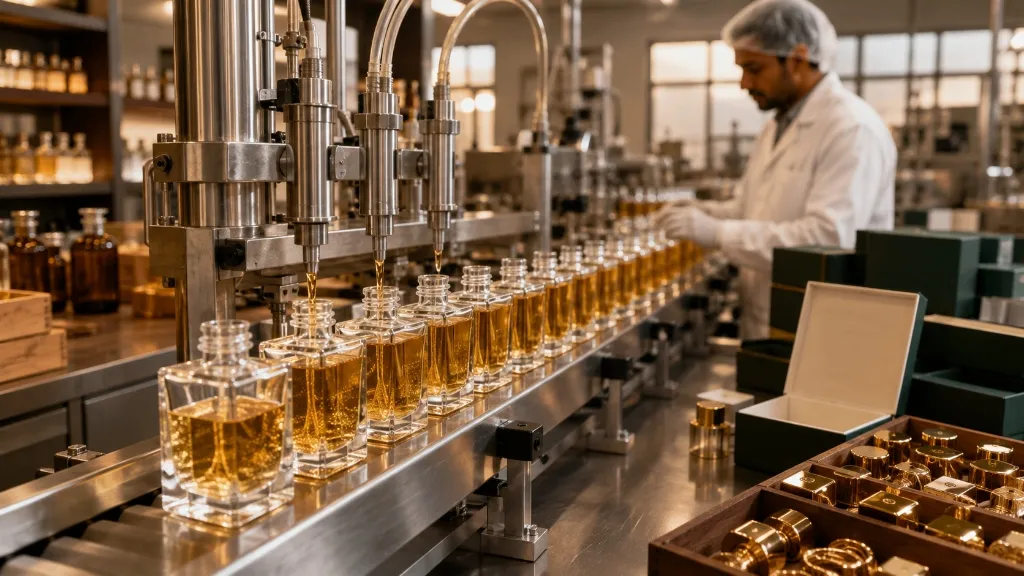
Private label manufacturing is how most perfume brands actually operate. The indie D2C label, the department store fragrance, the hotel amenity line — behind most of them is a manufacturing partner handling formulation, filling, and packaging while the brand focuses on the market.
This guide explains how the model works in India, what separates a good manufacturing partner from a mediocre one, and how to read a proposal.
Key Takeaways
- Private label means a manufacturer produces perfumes under your brand name
- India offers some of the most cost-competitive perfume manufacturing globally
- Look for end-to-end capability — fragrance, bottle, cap, packaging, filling, all under one roof
- MOQ as low as 1,000 units is available from select manufacturers
- Always verify ISO 9001, IFRA, and CE certifications before committing
What Is Private Label Perfume Manufacturing?
Private label perfume manufacturing is a business model where a manufacturer produces perfumes that are branded and sold by another company. The manufacturer handles:
- Fragrance development — Creating unique scent compositions or offering from a fragrance library
- Bottle manufacturing — Glass blowing, moulding, or sourcing stock bottles
- Cap and closure manufacturing — Zamac, ABS, wood, magnetic closures
- Packaging — Rigid boxes, folding cartons, sleeves, inserts
- Filling and assembly — Precision filling, crimping, labelling
- Quality control — IFRA compliance, stability testing, batch documentation
You, as the brand owner, control:
- Brand identity and positioning
- Marketing and sales
- Distribution and retail relationships
- Pricing and customer experience
- Product strategy and range planning
The result: you build a perfume brand without a factory, raw material warehouse, or in-house perfumer. Your capital goes into branding, marketing, and growth instead of infrastructure.
Types of Private Label Manufacturing Services
Full-service (end-to-end)
The manufacturer handles everything from fragrance to finished product. Ideal for startups and brands that want a single point of accountability.
At Fragrance & Fashion, this means six disciplines under one roof: fragrance composition, glass bottle manufacturing, cap and closure production, rigid box packaging, precision filling, and label application — all at our 10,000 sq. ft. Moriya, Ahmedabad facility.
Fragrance-only
You source bottles and packaging independently; the manufacturer provides only the fragrance (juice) in bulk. Lower control over quality consistency but more flexibility.
Fill-and-pack
You provide the fragrance and components; the manufacturer only fills and assembles. Suitable for brands that have established supply chains for components.
How to Evaluate a Private Label Perfume Manufacturer
Capability Checklist
| Capability | Why It Matters | Questions to Ask |
|---|---|---|
| In-house perfumers | Faster development, better reformulation support | How many perfumers on staff? Can I meet them? |
| Bottle manufacturing | Consistent quality, faster lead times | Do you blow glass in-house or source? |
| Cap manufacturing | Design flexibility, premium finishes | What cap materials do you work with? |
| Packaging | Brand consistency, coordinated timelines | Rigid boxes, cartons, or both? |
| Filling line | Hygiene, precision, capacity | What is your monthly filling capacity? |
| Quality lab | IFRA compliance, stability testing | Do you test in-house or outsource? |
Certifications to Verify
- ISO 9001 — Quality management system. Non-negotiable for any serious manufacturer.
- IFRA compliance — International Fragrance Association standards ensure your fragrances are safe for consumer use.
- CE marking — Required for selling in the European Union.
- GMP — Good Manufacturing Practices certification.
- BIS — Bureau of Indian Standards for domestic market compliance.
- UN-rated packaging — Required for international shipping of fragrances (classified as dangerous goods).
- IEC — Import Export Code, required if the manufacturer handles export logistics.
Pricing Models in Private Label Manufacturing
Per-unit pricing
The most common model. You pay a single per-unit price that includes all components and manufacturing:
| Product Type | Unit Size | MOQ |
|---|---|---|
| EDP | 100 ml | 1,000 |
| EDT | 100 ml | 1,000 |
| Attar | 6 ml | 1,000 |
| Body Mist | 200 ml | 1,000 |
| Car Perfume | 10 ml | 1,000 |
Final costs depend on fragrance concentration, bottle type, cap material, and packaging complexity.
Component-wise pricing
Some manufacturers break down pricing by component — useful for understanding where costs lie and where to optimise:
- Fragrance (juice): 15–25% of total
- Glass bottle: 12–18%
- Cap/closure: 8–12%
- Packaging (box, insert): 10–15%
- Filling, crimping, labelling: 5–8%
- Quality control, documentation: 3–5%
Tooling and development fees
Custom moulds, dies, and fragrance development may carry one-time tooling charges:
- Custom bottle mould: Varies depending on design complexity
- Custom cap mould: Depends on material and intricate details
- Packaging die: Varies by packaging format
- Fragrance development: Often absorbed into per-unit pricing for private label
The Private Label Manufacturing Process
Working with a manufacturer like Fragrance & Fashion typically follows this timeline:
- Brief and consultation (Day 1–3) — Share your brand positioning, target audience, budget, and fragrance preferences. Send a brief.
- Fragrance sampling (Week 1–3) — Receive 3–6 fragrance samples based on your brief. Test, provide feedback, iterate.
- Component selection (Week 2–4) — Choose bottles, caps, and packaging from the manufacturer's library or commission custom tooling.
- Design and artwork (Week 3–5) — Finalise packaging design, label artwork, and print specifications.
- Pre-production sample (Week 4–6) — Receive a complete finished unit for final approval.
- Production run (Week 5–8) — Full manufacturing process from filling to packaging.
- Quality check and dispatch (Week 7–10) — Final QC, batch documentation, and shipping.
What Makes Fragrance & Fashion Different?
Fragrance & Fashion has been manufacturing perfumes in Ahmedabad since 2015, building on a fourth-generation family legacy in perfumery.
- 240+ brands launched — From first-time founders to established houses, domestic and export
- 1,000 unit MOQ — Among the lowest in India for a full-service manufacturer
- End-to-end facility — Everything under one 10,000 sq. ft. roof in Moriya, Ahmedabad
- 12+ export markets — EU, UK, GCC, US, Canada, SE Asia, Australia, Africa
- Certified — ISO 9001, IFRA, CE, FDA, UN-rated packaging
How we work with brands
We don't just manufacture — we partner. From fragrance development to packaging design, we work closely with brand founders to create products that reflect their vision and meet market standards.
See how we've worked with brands like Hoor 72, Bombay Lab, and Drooks Lifestyle.
Red Flags When Choosing a Manufacturer
Watch for these during your manufacturer evaluation — any one of them should give you pause:
- No factory visit policy — Any legitimate manufacturer should welcome facility visits
- No certifications — If they can't produce ISO/IFRA certificates, walk away
- Unrealistically low prices — Below-market pricing often means compromised ingredients or recycled materials
- No reference clients — Established manufacturers should be able to share case studies or references
- No written agreements — Always get production specs, timelines, and pricing in writing
- Gmail or generic email addresses — Professional manufacturers use business email domains
Getting Started
Ready to explore private label manufacturing? Here's how to get moving:
- Put together a brief — Brand name, target customer, fragrance direction, budget range, and expected volumes
- Send it over — Our team responds within 2 business days with capability fit and indicative pricing
- Come see the facility — Our Moriya, Ahmedabad manufacturing centre is open for tours
- WhatsApp us — For quick questions or to set up a call
We've helped 240+ brands launch and scale — from startups launching their first SKU to established houses scaling production across continents.
Frequently Asked Questions
Private label perfume manufacturing is when a third-party manufacturer creates perfumes that are sold under your brand name. The manufacturer handles fragrance development, bottle production, filling, packaging, and quality control — while you own the brand, design, and customer relationships. It's the most capital-efficient way to launch a perfume brand.
Manufacturing costs vary by fragrance concentration, bottle type, and packaging complexity. The final per-unit cost depends on your specifications and order volume. Fragrance & Fashion provides detailed cost breakdowns during the quoting process tailored to your brand's requirements.
In private label manufacturing, the manufacturer may help develop the product formulation and offers ready-made bases that you brand as your own. In contract manufacturing, you provide the exact formula and specifications, and the manufacturer simply produces to your spec. Many manufacturers, including Fragrance & Fashion, offer both models.
Yes. Most reputable private label manufacturers will develop exclusive formulations for your brand. At Fragrance & Fashion, all custom-developed fragrances are exclusive to your brand — we do not sell the same composition to other clients. Stock fragrances from our library, however, are available to multiple brands.
MOQ varies widely across manufacturers in India — from 500 to 10,000+ units. Fragrance & Fashion offers an MOQ of 1,000 units, which is among the lowest for a full-service manufacturer. Larger manufacturers may require 5,000–10,000 units minimum, which isn't ideal for startups or test launches.
 Startup Guides
How to Start a Perfume Brand in India: Complete 2026 Guide
How to launch a perfume brand in India. From choosing a manufacturing partner and developing fragrances to licensing, packaging, and your first production run with MOQ as low as 1,000 units.
 OEM Manufacturing
OEM vs Private Label Perfume Manufacturing: Key Differences Explained
Understand the differences between OEM and private label perfume manufacturing. Compare ownership, control, pricing, MOQ, and which model suits your brand.
 Perfume Manufacturing
Perfume Manufacturing Process: 6 Steps from Fragrance to Finished Product
A detailed look at the perfume manufacturing process, from fragrance composition to retail-ready packaging. Understand how private label perfumes are made in a modern facility.